Latest Developments in Digital Marketing
Latest Developments in Digital Marketing

Care Finder Program

Digital marketing is evolving rapidly, driven by increased use of artificial intelligence, automation, and data-led decision-making across major platforms. Recent updates from Google, Meta, and AI-native tools reflect a broader shift away from manual optimisation and towards predictive, machine-led systems.

For businesses operating across B2B and B2C environments, these developments require a renewed strategic assessment, utilising quality data, and the setting of clear performance metrics.

Beyond Google and Meta, AI-native platforms are beginning to introduce new forms of commercial visibility. Sponsored responses, conversational recommendations, and contextual placements within AI tools are emerging as early-stage advertising opportunities.

While still evolving, these formats signal a future where discovery happens within AI-driven interfaces, not just traditional search engines or social feeds. Understanding the continuous evolution of various digital marketing platforms is essential for ensuring marketing activities are not just visible, but targeted and efficient.

Text vs Video Formats

While text ads are still relevant for immediate and cost-effective conversions of searches backed by clear intent, short-form video (TikTok, Reels, YouTube Shorts etc) is now dominating and excels at building brand awareness and engagement.

Videos enable viewers to form an emotional connection through storytelling and boast retention rates 9 to 10 times above that of text. They also come with an increased cost of production which advertisers must weigh up in the context of their strategic goals and potential return.

Companies can use video to tell their brand stories – whether that’s highlighting their history, sharing customer reviews, showcasing products, or offering behind-the-scenes insights.

There is no question about the power of video as it offers a way into the lives of viewers who can empathise and see themselves in the subjects within the stories. Video captures attention on a deep emotional level and creates an immersive experience.

The Shift Toward AI-Led Platforms

Google and Meta are no longer simply advertising platforms. They are increasingly functioning as decision engines that use machine learning to determine:

    • audience preferences and behaviours,
    • targeting methodology,
    • creative delivery, and
    • budget allocation.

Rather than reacting to manual inputs, these platforms now optimise digital marketing activities based on patterns, signals, and predicted outcomes.

This shift reduces hands-on control but increases the importance of strong foundational inputs, including accurate conversion tracking, clear messaging, and well-structured campaigns which are optimised across the range of output locations such as Facebook, Instagram, Google and other top ranking search engines such as YouTube (which is now the second largest search engine in the world).

Recent Updates in Google Advertising

Google continues to prioritise automation across its advertising ecosystem. Smart bidding, broad match, and Performance Max campaigns are now seen as low-value, entry level solutions rather than advanced options. Similarly, manual Cost Per Click (CPC) strategies are not supported by Google and the platform has zero accountability to deliver a lead, often resulting in budgets being exhausted and blackout periods.

In parallel, search results are becoming more visual and summarised, with AI-generated overviews reducing traditional organic and paid click opportunities. This places greater importance on structured content, strong brand signals, and accurate first-party data.

To make the most of Google’s AI tools, advertisers need to spend time getting to know their target market, preferred methods for conversion and the associated value of each conversion to their business (either a specific value or a ranking). This information informs implementation of a ‘Maximise Conversion’ bidding strategy with values attributed to leads based on their quality. This gives Google Ads the accountability to only drive high value conversions and reduces the likelihood of blackout periods.

Meta Advertising and AI-Driven Optimisation

Meta’s advertising platform has undergone similar changes, with increased input from AI to manage audience targeting, creative rotation, and delivery optimisation.

Advertisers are encouraged to provide broader creative inputs and allow the platform to determine which combinations perform best. While this improves efficiency, it also reduces transparency, making performance monitoring and testing frameworks more important than ever.

However, where determining best performing ads once centred around traditional manual A/B testing (e.g. headline or imagery tests), AI advancements and automated tools like Advantage+ campaigns allow Meta’s algorithm to determine the best creative, often making manual split testing unnecessary.

What About ChatGPT?

If we are talking about OpenAI, then we must acknowledge the question on everyone’s lips – “Is ChatGPT offering advertising and how is this going to change things?”

The answer is that ChatGPT is still in the pilot stage of testing ads within the USA, with advertising designed to be integrated within the chat flow, as opposed to traditional banner ads, although still clearly labelled as ‘sponsored’.

OpenAI (creator of ChatGPT) has stated that responses to user questions will not be influenced by advertisers, but rather advertisers will only be shown where the model detects high intent search from the user.

Cost is currently uncertain but is expected to be higher than current placements (per-thousand impressions), based on ChatGPT’s positioning as a ‘premium’ channel that receives high-engagement and intent qualification.

Testing hasn’t yet reached Australian audiences and we expect considerable refinement will take place before a mass rollout.

What Do These Changes Mean?

Automation increases efficiency but heightens competition for attention. The key takeaway from these developments is that clear value propositions and consistent messaging are critical. AI-driven platforms reward clarity, relevance, and strong data signals over short-term tactics.

For organisations operating in an environment of longer decision cycles, digital marketing strategies must focus on education, building trust, and sustained visibility across multiple touchpoints.

KLR Communications works with organisations to interpret platform changes and translate them into practical digital marketing strategies. This includes aligning campaign structure, conversion tracking, content strategy, and reporting frameworks to ensure AI-driven platforms are guided by accurate, business-relevant inputs.

By focusing on strategy, measurement, and continuous optimisation, KLR Communications helps clients maintain control and clarity in increasingly automated environments.

How KLR Communications Can Assist You

As digital marketing platforms continue to evolve, clarity and structure are more important than ever.
Contact Us to understand how recent digital marketing developments affect your organisation and how to adapt your strategy for long-term performance.
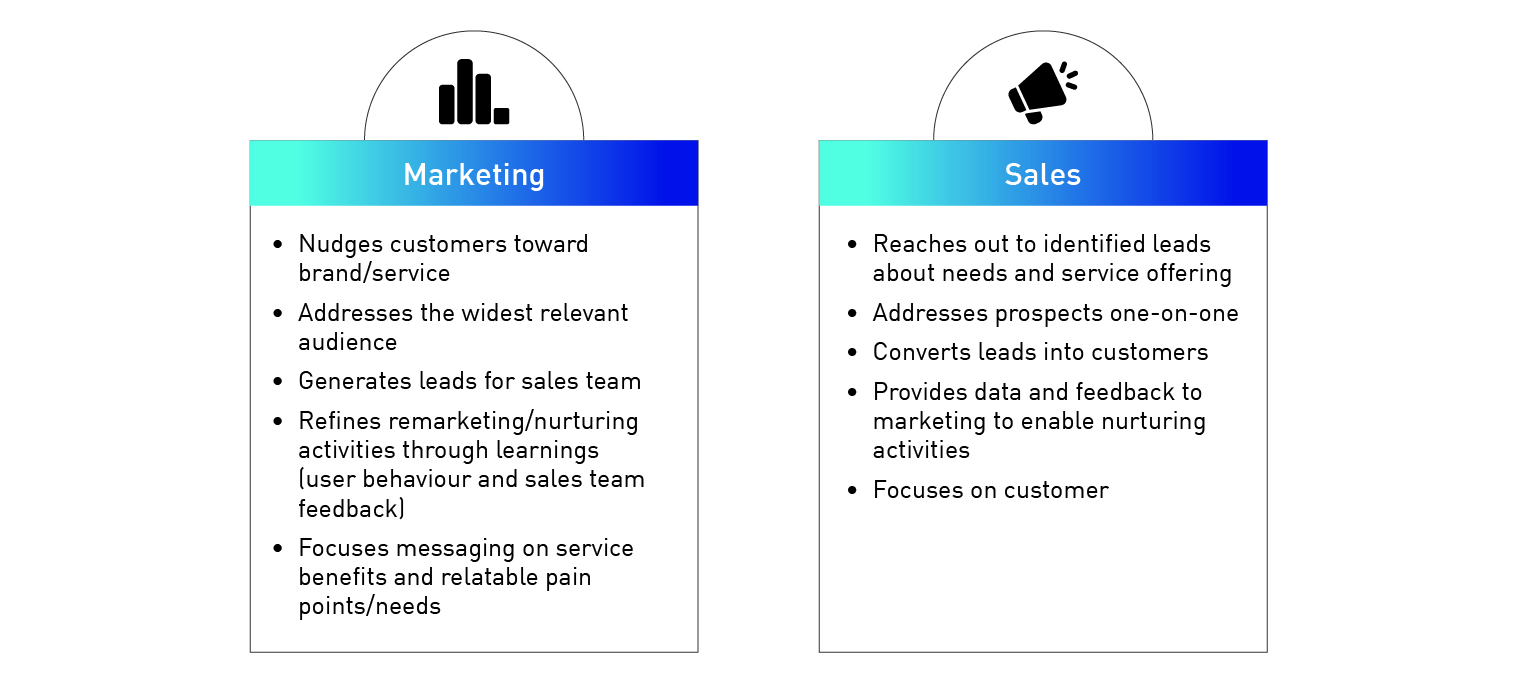
The Key Differences Between Marketing and Sales

The Key Differences Between Marketing and Sales

Care Finder Program

Across both B2B and B2C organisations, the journey from first awareness to final decision rarely happens instantly. People often interact with multiple touchpoints before they speak directly with a sales team or complete a purchase.

Understanding the difference between marketing and sales helps clarify how leads, enquiries, or customers are attracted, supported, and ultimately converted. While the buying context may differ between B2B and B2C, the core roles of marketing and sales remain distinct but closely connected.

Clear alignment between these functions leads to better visibility, stronger outcomes, and more accurate expectations around performance and return on investment.

Marketing vs Sales, What Is the Difference?

Marketing focuses on building awareness, visibility, and engagement to populate the sales funnel with potential, qualified customers.

Through activities such as graphic design, website development, digital marketing and carefully crafted communications, its role is to attract the right audience, communicate value clearly, and encourage potential customers to signal interest through following various calls to action (CTAs).

In B2C environments, marketing influences individual purchasing decisions through advertising, content development and the development of a recognisable and consistent brand presence. In B2B, marketing supports longer decision cycles through stakeholder education and  the establishment of credibility.

While many B2C purchases are low-consideration or ‘transactional’, others, such as those related to personal services, are deemed higher risk and marketing must take a longer-term approach to assist potential customers  to consider benefits and risks and to compare various offers.

Customers looking at high-risk purchases assess and measure offers based on perceived trust, suitability, risk, and long-term value. Ongoing nurturing requires marketing and sales to work together to provide information and hold meaningful sales conversations involving analysis of individual needs and circumstances and clear articulation of benefits and outcomes.  In these cases, B2C sales can closely resemble B2B processes.

Marketing supports these interactions by setting expectations early and ensuring enquiries are well-informed before sales engagement begins. This alignment is most effective when guided by a clear, well-defined marketing strategy that identifies audience needs, suitable marketing channels, and measures of success..

Sales focuses on direct engagement and conversion. In B2C, this may involve assisted purchasing or customer service. In B2B, it typically involves deeper discovery, negotiation, and onboarding.

Marketing supports sales by capturing informed, relevant enquiries or customers. Sales converts identified interest into completed transactions, service agreements, or long-term relationships.

Together, marketing and sales work as a connected system, with marketing generating informed enquiries and sales converting interest into outcomes.

The Customer Journey

Customer journeys differ in length and complexity between B2B and B2C, but both follow a similar structure.

In B2C, the journey is often shorter and driven by individual needs, urgency, or emotion. In B2B, the journey is usually longer and influenced by budgets, proposal and approval processes, and multiple decision-makers.

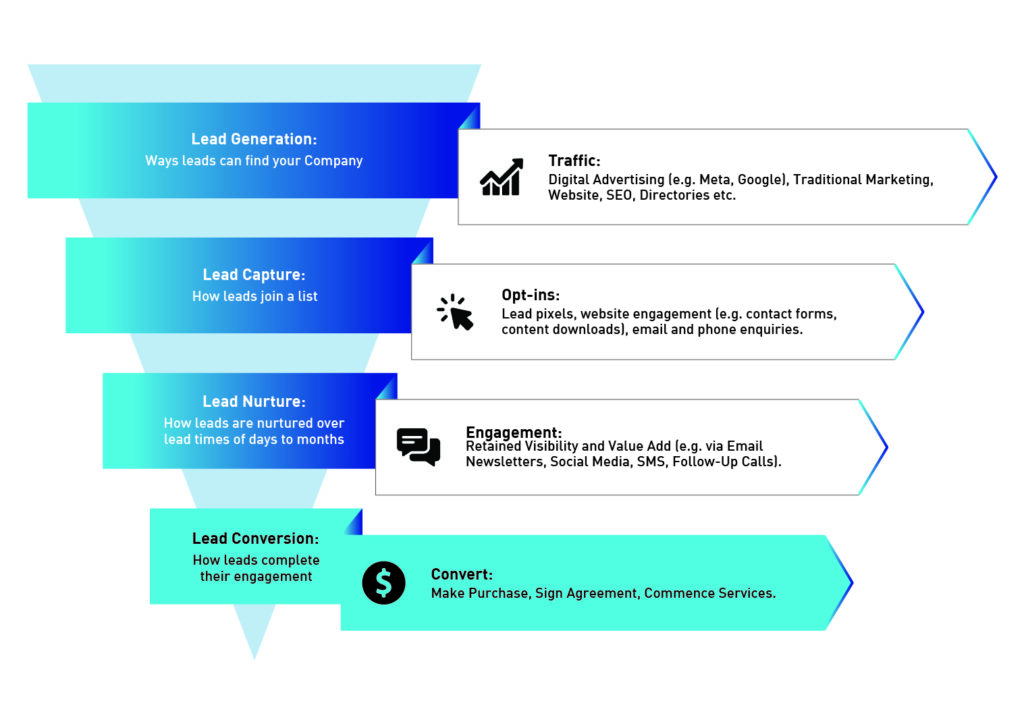
Despite these differences, the journey typically includes four stages:

  • Lead Generation – how people first discover a product or service
  • Lead Capture – when interest is expressed through a purchase, enquiry, or contact action
  • Lead Nurturing – continued engagement for those not ready to proceed immediately
  • Lead Conversion – when a purchase is made or an agreement is finalised

Understanding this journey helps organisations support customers and prospects appropriately at every stage.

Why Lead Nurturing Matters

Not all B2B or B2C enquiries convert immediately. Timing, budget, competing priorities, or confidence can all influence when someone is ready to proceed.

Lead nurturing helps build and maintain visibility, trust and credibility over time. In B2C, this may involve sending reminders or new offers and enticements, sharing free information, or providing reassurance through outcomes and testimonials. In B2B, nurturing often includes educational content, follow-ups, and relationship building.

Strong collaboration between marketing and sales improves nurturing outcomes. Feedback loops from sales teams to marketing teams helps refine messaging and ensure communication reflects real customer questions and concerns.

How Marketing Activity Is Tracked

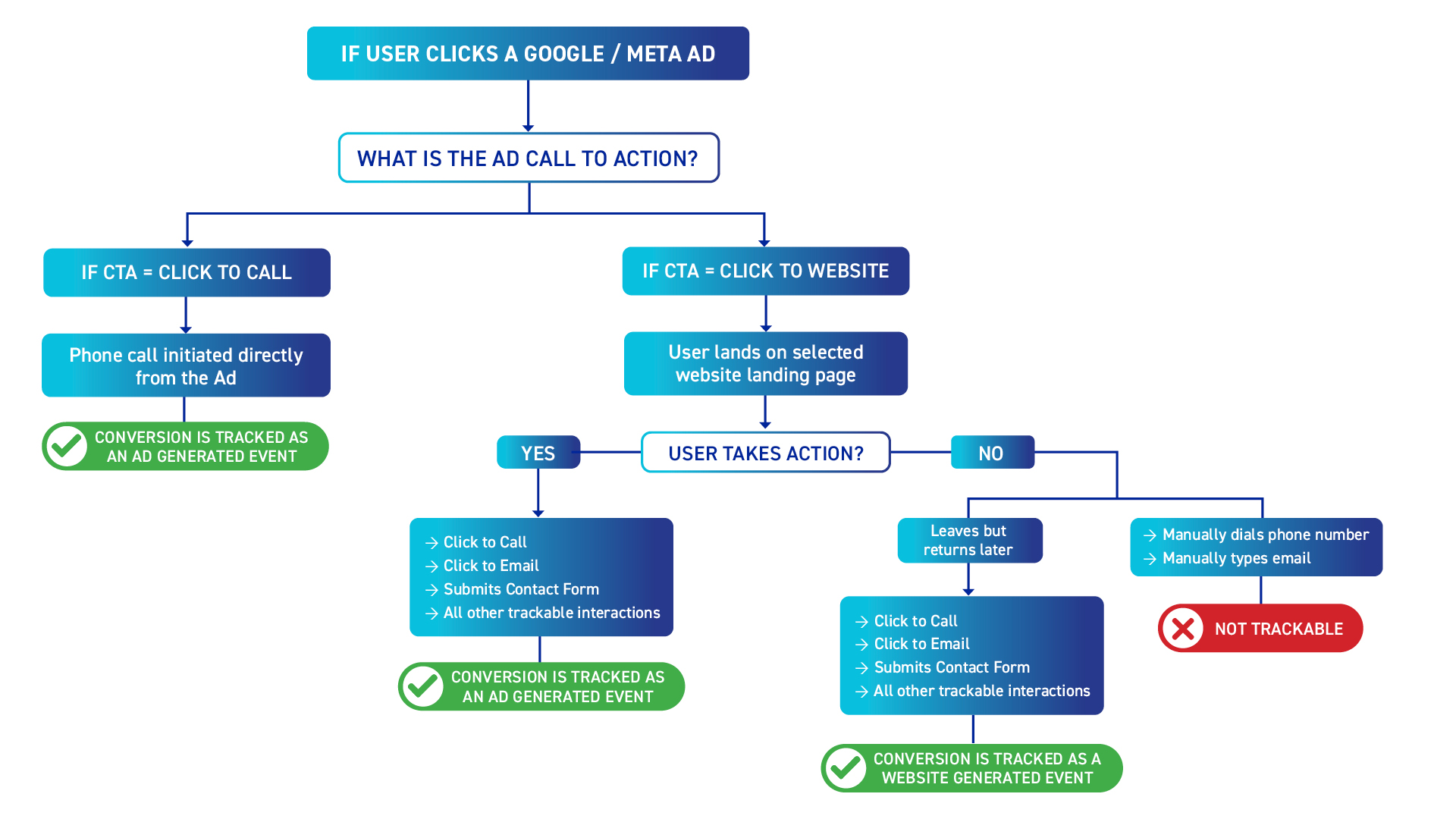
Marketing typically tracks actions that occur across digital and campaign channels, including:

  • Form submissions or purchases
  • Clicks to call or email
  • Content downloads
  • Event registrations, enquiries, or demonstration requests

These actions are commonly referred to as ‘conversions’ within marketing platforms.

It is important to distinguish between tracked marketing actions and final sales outcomes, which occur later in the sales or purchase process. The below diagram depicts a typical flow of trackable events and lead capture via a digital ad (Google and Meta) campaign.

Working Together for Better Outcomes

Marketing and sales are most effective when they operate as a connected system rather than isolated functions. Feedback loops are imperative where ‘non-trackable’ events result in identification of additional leads. Sales and marketing pursuit lists must be integrated to ensure nuturing activities are complimentary and not conflicting.

Marketing builds awareness, credibility, and intent.

Sales builds trust and relationships through direct interaction and guidance. When feedback flows consistently between both, conversion improves, decision cycles shorten, and customer experiences are stronger across both B2B and B2C environments.

Clear separation, yet integrated alignment between marketing and sales is critical to achieving growth and return on investment.

KLR Communications partners with leadership teams to design marketing frameworks that deliver measurable impact. To discuss how we can assist your business to strategically build and execute your next integrated marketing campaignContact Us.

Successful tender to deliver Multicultural Health Navigator Service

Successful tender to deliver Multicultural Health Navigator Service

Care Finder Program

Following a competitive tender process, KLR Communications’ client Advance Diversity Services has successfully secured $836,350 in funding to deliver the Multicultural Health Navigator Service in the Sydney and South Eastern Sydney Local Health Districts from 1 January 2025 to 30 June 2026.

The Multicultural Health Navigator Services aims to enhance health equity by bridging gaps in health service access for members of culturally and linguistically diverse communities.

Advance Diversity Services’ bi-lingual navigators will link people with appropriate services and help to improve health literacy and an understanding of the Australian health and social systems across target populations including: Mandarin and Cantonese, Arabic, Korean, and Nepali.

The service will support people between the ages of 18 – 65 years, who have limited or no English proficiency and who require support navigating the Australian health and social systems.

Advance Diversity Services is a leading non-profit organisation that builds community, brings cultures together and promotes justice, equality and respect. They provide a range of community, aged care, family, disability and settlement services to enhance the health, wellbeing and community connections of individuals and families in St George, the Sutherland Shire, and Inner Sydney.

We are delighted to be a part of this further win for Advance Diversity Services, which builds on their SETS Program tender win just 6 months prior”, said Kathryn Garth, Managing Director, KLR Communications.

To discuss how KLR Communications may assist your business with your next project or tender application, Contact Us.

$1.1 million secured in latest CHSP funding round

$1.1 million secured in latest CHSP funding round

CSHP

KLR Communications, with our partner SoCom Consulting, are delighted to have assisted our clients to secure almost $1.1 million in funding to deliver CHSP services from 1 November 2024 to 30 June 2025. With the expected option to extend to 30 June 2027, the value of these contracts totals more than $4.4 million.

In what was the most competitive CHSP grant round to date, funding applications exceeded the available budget by more than 20 times. 1201 applications were submitted, totalling more than $2 billion, while only $100 million was available.

The Commonwealth Home Support Programme assists senior Australians to access entry-level support services which enable them to live independently and safely in their own home for as long as possible.

KLR Communications and SoCom Consulting worked together to secure funding for clients across Aged Care Planning Regions (ACPRs) in New South Wales, South Australia, Western Australia and the Northern Territory, for the delivery of services including:

  • Domestic Assistance
  • Home Maintenance
  • Allied Health and Therapy
  • Transport services

SoCom Consulting has developed a suite of documents to assist successful applicants in the provision of CHSP services, including:

    To discuss how KLR Communications may assist your business with your next project or tender application, Contact Us.

    Funding secured to deliver Settlement Engagement and Transition (SETS) Program

    Funding secured to deliver Settlement Engagement and Transition (SETS) Program

    Care Finder Program

    Following a competitive tender process, KLR Communications’ client Advance Diversity Services has successfully secured funding to continue delivery of the Settlement Engagement and Transition Support (SETS) Program on behalf of the Department of Home Affairs.

    Advance Diversity Services has been delivering SETS Client Services and Community Capacity Building activities since 2015. Securing more than $2 million in further funding enables the ongoing provision of supports for humanitarian entrants and other eligible vulnerable migrants so they may improve social and economic participation, and community connectedness.

    For an additional 3-year period, Advance Diversity Services will provide low and medium-intensity case management and group sessions in support of clients to obtain settlement-related advice, to receive referrals into mainstream services, and to gain assistance to navigate the Australian service system.

    Advance Diversity Services will deliver the Program in 4 NSW Statistical Areas (Hurstville, Kogarah-Rockdale, Cronulla-Miranda-Caringbah, and Sutherland-Menai-Heathcote) via team of Multicultural Support Workers with fluency in Mandarin, Cantonese, Arabic, Nepalese, Thai, Bengali, Russian, Ukrainian and more.

    This is the second time that Kathryn and KLR have supported us to prepare a successful tender!  Kathryn helped our internal tender team to prepare and win an important bid to provide services under the Settlement Engagement and Transition Support (SETS) Program. KLR were great to work with. Professional, impactful and cost effective. We will definitely engage their services again in the future!”, said Thanh Nguyen, Manager, Business Development and Quality, Advance Diversity Services.

      To discuss how KLR Communications may assist your business with your next project or tender application, Contact Us.

      Tender success ensures ongoing support for families and children across Sydney

      Tender success ensures ongoing support for families and children across Sydney

      Care Finder Program

      KLR Communications congratulates our client Weldon Children’s Services on a number of recent and well-deserved tender successes allowing this impressive organisation to continue supporting families and children across Sydney.

      Weldon is a not-for-profit community organisation catering for children from birth to 12 years of age providing early years education and care to families most in need. Services include:

      • before school care, after school care, care on
      • pupil free days during school term; and
      • vacation care during school holidays.

      The KLR team worked with Weldons late last year in a tender process to successfully secure their place as Outside Ordinary School Hours (OOSH) provider at 3 schools across Sydney, ensuring consistency in care for children who have developed strong bonds with their carers.

      “Recently the team successfully assisted Weldon in being re-appointed as OOSH providers in multiple locations by supporting us through an EOI process. They take the time to really understand what the desired outcomes are and what is needed to provide a winning submission,” Deborah Moran – CEO Weldon Children’s Services.

      In addition, KLR worked with Weldons to secure development grants for 5 of their OOSH programs. The Development Grant Program aims to encourage and support projects, initiatives and programs that are designed to increase the viability of an approved service. Through securing important funding, Weldons is now able to further develop their programs, develop the expertise of their educators and obtain exciting new equipment and supplies that promote physical activity and development for children.

      “KLR Communications supported Weldon through a successful grant application process that resulted in Weldon obtaining significant grants for 5 of our Out of School Hours programs. Kathryn and her team are highly professional. I highly recommend engaging [them] to support any organisation going through a tender or grant application process,” Deborah Moran – CEO Weldon Children’s Services.

        To discuss how KLR Communications may assist your business with your next project or tender application, Contact Us.

        []